With 3Arts at GIA

I just returned from Philadelphia, where I attended the GIA Support for Individual Artists Preconference as an artist respondent, and then introduced the image below at the main conference, on a panel that centered on communication between artists and grantors, with Sean Elwood, Caitlin Strokosch, Paul Tyler and Sasha Yanow.

Image

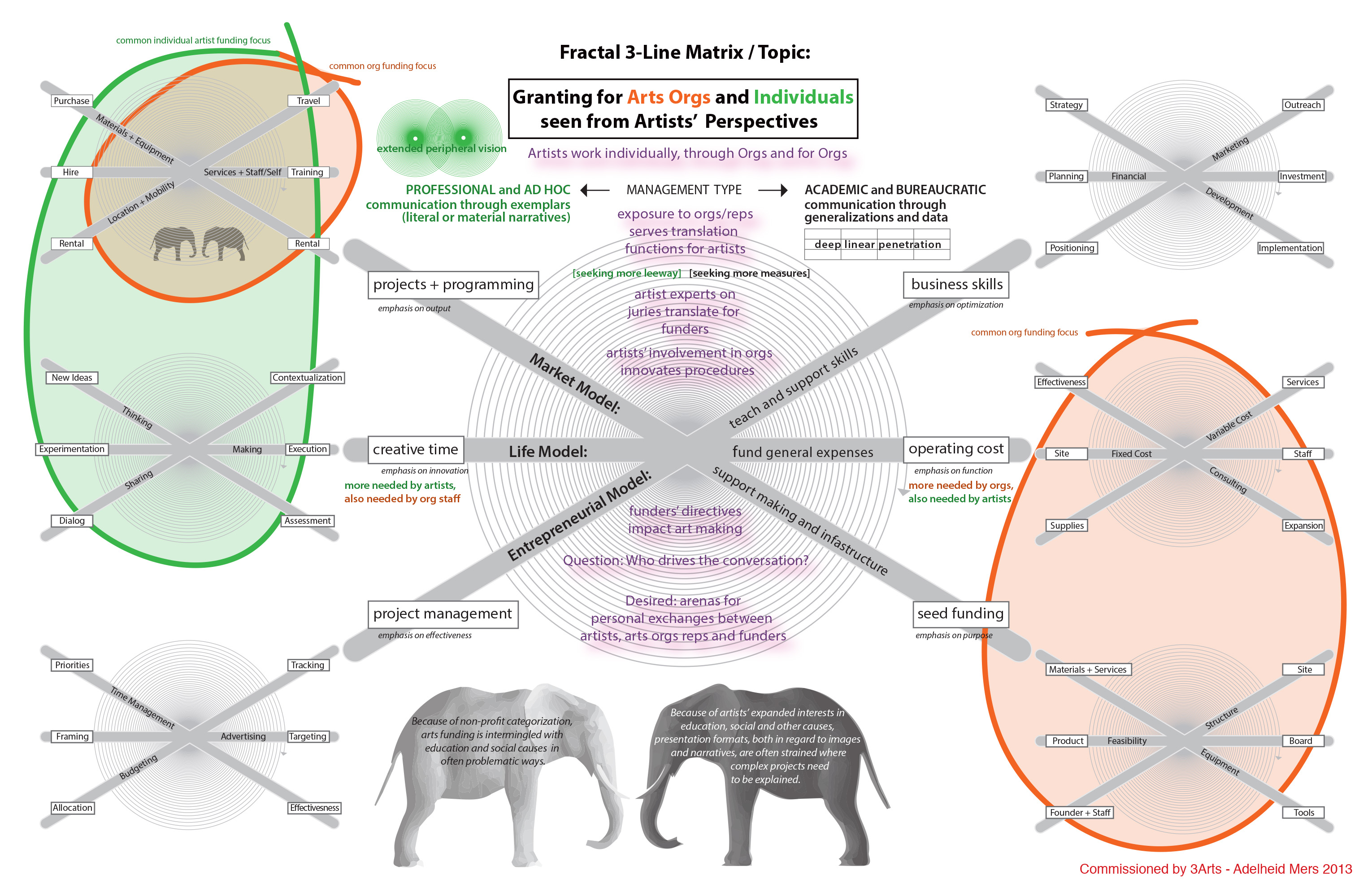
This diagram was commissioned by Esther Grimm for 3Arts. The initial premise of the commission was to discuss with artists how not winning a grant might impact them. This expanded to a larger catalog of questions about how artists engage with grant writing. What eventually emerged was an image of the ecology of support for the arts as seen by artists. Three points seem particularly noteworthy. 1. Project funding, offered mainly through re-granting organizations, has become the prevalent opportunity (top left, the overlapping green and orange bubbles). It requires facility with specific types of narratives. 2. Artists continue to be highly interested in longer term, unrestricted funding (the green area.)  They also desire to drive the conversations more freely. 3. Many artists also work with or have started their own organizations, in part to regain some of the control that has been shifted from artists to organizations, in the wake of the Culture Wars. Exposure to and participation in organizations creates knowledge of their languages and ecologies, and with that advantages in funding work in the current climate. Aware of that impact, funders have created ‘entrepreneurial’ programs to extend this knowledge to artists who currently don’t engage with organizations. These programs are not necessarily appreciated.

These observations were identical to what other artists stated at the conference. Most eloquently, writer Quiara Alegria Hudes pleaded in her keynote for the benefits of support for entire creative cycles, by presenting her own experience. One thing is clear: funders have heard the message.

What I am bringing back from the conference in addition to confirmations of the above is an awareness of just how actively funders are seeking to build audiences for the arts, and to engage cultural producers who are not currently seeking their support. This allows me to better contextualize some of my upcoming activities, located on the South and West sides of Chicago.

Posted in 3Line_Matrix, conferences

SAIC Sabbatical Exhibition

Coming in December 2013:

I will show new work at SAIC Faculty Projects at the Sullivan Galleries.

empty

December 14, 2013–February 15, 2014
Reception: Friday, December 13, 4:30–7:00 p.m.

This program is partially supported by a grant from the Illinois Arts Council Agency.


Posted in 3Line_Matrix, exhibitions

Useful Pictures at the Evanston Art Center

Here’s documentation: 

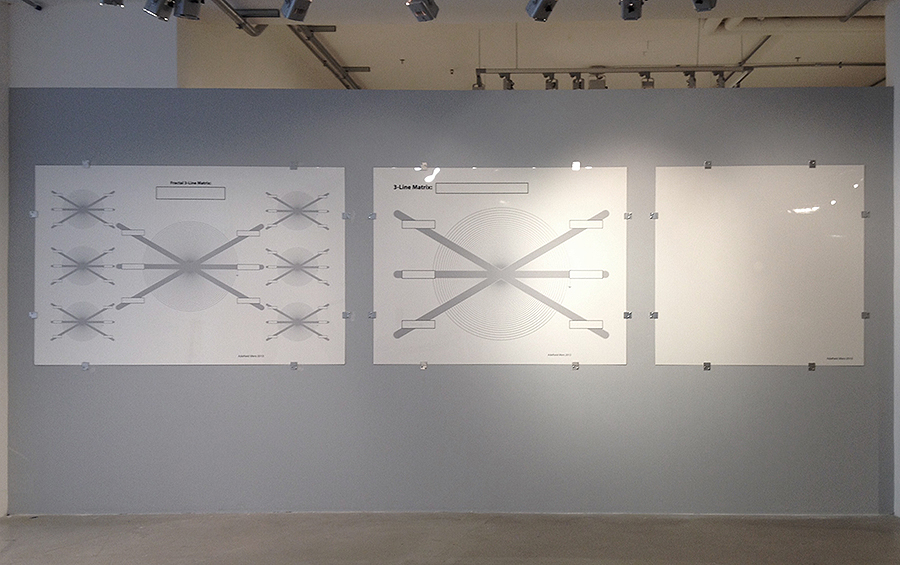
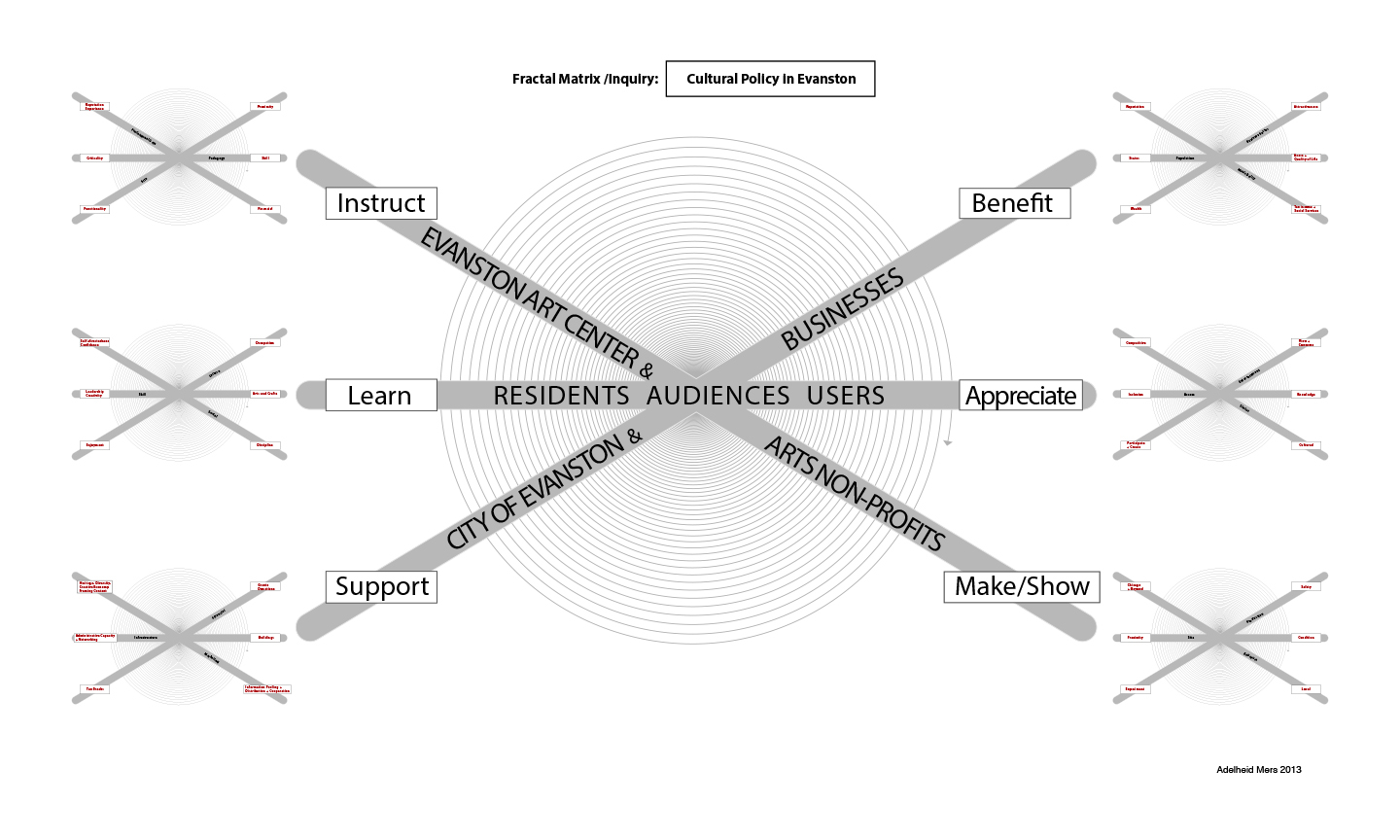
Useful Pictures at the Evanston Art Center, featuring the first Fractal Matrix:

Image

Posted in 3Line_Matrix, exhibitions, facilitating

Useful Pictures at the Evanston Art Center, September 9 – 22, 2013

Image

Useful Pictures at the Evanston Art Center

September 9 – 22, 2013

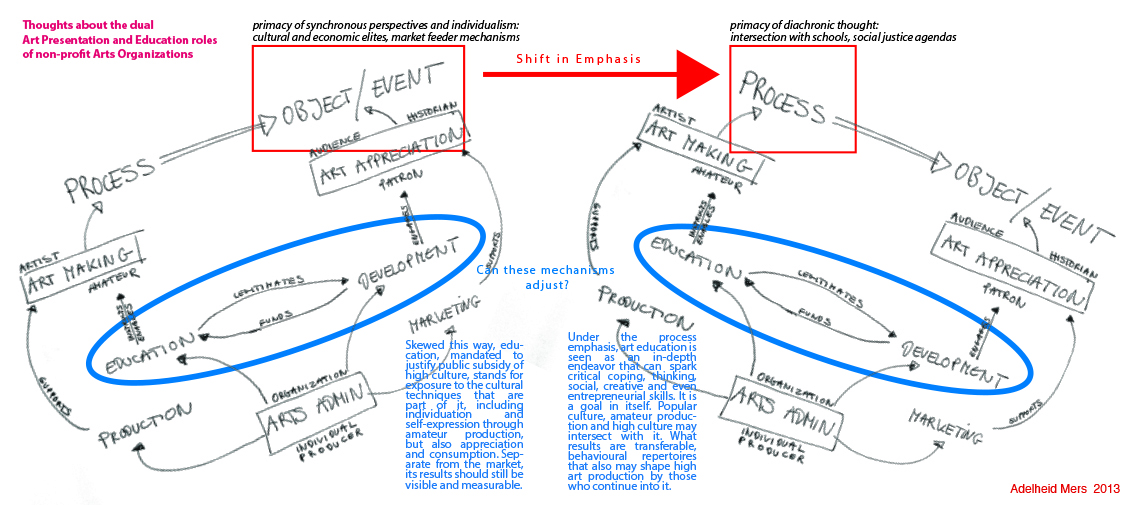
In the context of an Arts Economies seminar, a group of SAIC Arts Administration and Policy graduate students, with professor Adelheid Mers, were invited by the Evanston Art Center to study the arts ecology of Evanston. A goal was to better understand the roles that art centers play in their home communities, navigating a complex set of interests and serving multiple publics.

Over six weeks, the students conducted interviews with Evanston based artists, arts administrators and educators. Those interviews were facilitated through mapping and diagramming activities, which are further developed and presented publicly as the Evanston Art Center becomes a lab for two weeks, beginning on September 9. Over the course of the public presentation that shows traces and interpretations of conversations in progress, students will be on site as often as possible, to discuss what they found. You may also contact Adelheid Mers at amers@saic.edu to schedule appointments.

Join us Saturday, September 21, from 3-5pm for a roundtable discussion with Evanston Art Center Executive Director Norah Diedrich and Director of Education Keith Brown.

  • Adelheid Mers, Associate Professor, Chair, Arts Administration and Policy
  • Gabrielle Burrage, MA Arts Administration and Policy
  • Cassie Carpenter, MA Arts Administration and Policy
  • Jenni Groot, MA Arts Administration and Policy
  • Raven Falquez Munsell, MA Arts Administration and Policy & MA Art History,
  • Gan Uyeda, MA Arts Administration and Policy & MA Art History

Many thanks to:

  • Joshua Allard, Artistic Associate, Piccolo Theatre
  • Jon Arndt, Managing Director, Next Theatre
  • Brenda Barnum, artist
  • Keith Brown, Director of Education, Evanston Art Center
  • Leslie Brown, Executive Director, Piven Theatre Workshop
  • Amina Dickerson, President, Dickerson Global Advisors, LLC.
  • Norah Diedrich, Executive Director, Evanston Art Center
  • Christina Ernst, Co-Artistic Director, Evanston Dance Ensemble
  • Rick Ferguson, Director, The Musical Offering
  • Michael Gonzalez, Intern, Evanston Art Center
  • Justin Hart, Midwest Clay Guild
  • Ariel Hartman, Front Desk Receptionist, Evanston Art Center
  • Alicia Hempfling, Administrative Coordinator, Boocoo Cultural Center and Cafe
  • Mie Kongo, artist
  • Michael Miro, Executive Director, Mudlark Theater Company
  • Adriana Poterash, Midwest Clay Guild
  • Béa Rashid, Dance Center Evanston, Director
  • Faiz Razi, artist
  • Tim Rhoze, Artistic Director, Fleetwood-Jourdain Theatre
  • Dino Robinson, Jr., Shorefront Legacy Center, Founder
  • Karla Rindal, Open Studio Project, Facilitation Director
  • Matthew Runfola, artist
  • Tess Stevens, Evanston Art Center, Intern

A little more context: 

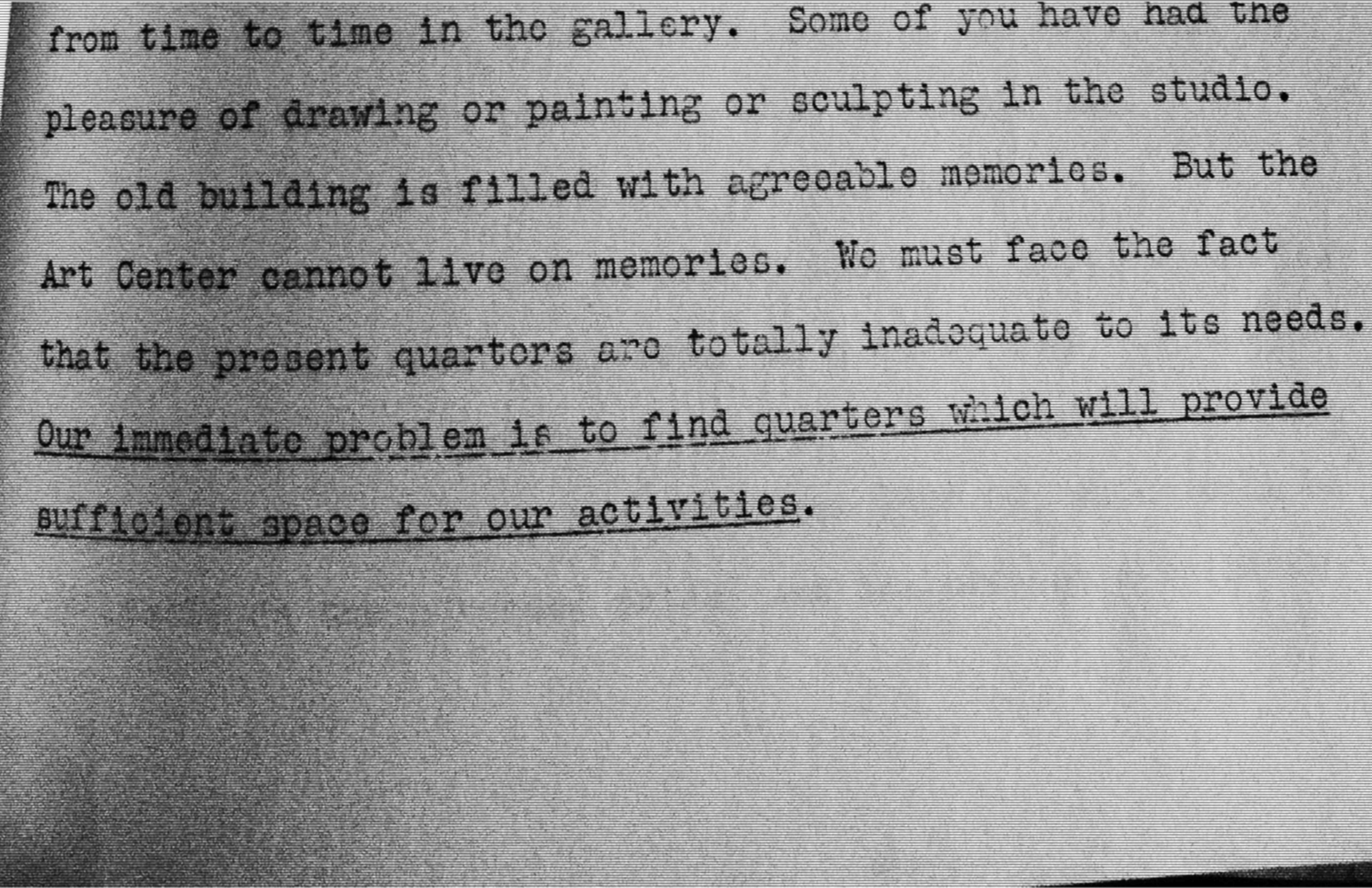
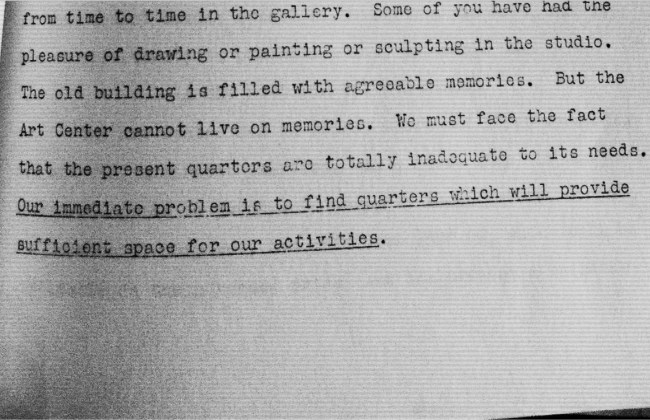
Evanston has a long history of supporting and discussing the arts (The quote pictured above, from the EAC archives, dates to the 1940’s). Recently, there have been surveys and other cultural planning activities. Worldwide, the arts are being reconsidered: as economic drivers, as part of urban planning efforts and as sources of a more broadly understood creativity. These considerations can be highly controversial. They require critical perspectives. As our economies are changing, they should not be ignored. The Evanston Art Center has long been part of these conversations, while it has also undergone a number of incarnations.

We set out to examine arts organizations of Evanston based on a model of cultural ecology. In an ecology, entities try to survive in an environment by competing against each other or working together towards common goals. Those that are successful reproduce their practices and those that are not fall away. Looking beyond the internal structures of the arts groups, we wanted to see the ways that opportunities and restrictions within the cultural environment shape how the arts are offered in the city.

The diagrams displayed here are conversations made visual. Engaging community participants in dialogues about art, culture, education, and politics in Evanston, we tracked the conversations as they unfolded through collaborative mapping. These conversation maps helped to guide discussion and track important points and trends. In turn, we re-interpreted the maps as three line diagrams that organize the big ideas and highlight the central relationships of each conversation.

Our findings are not scientific, and they are not definitive. Rather, they open onto new conversations about the fluidity of organizational identity and the navigation of legacy and potential. This exhibition is built upon the immense generosity of the  individuals who shared their time and ideas with us, and we thank each of them for their contributions and kindness.


http://www.evanstonartcenter.org/

2603 Sheridan Road, Evanston IL60201

T: (847) 475-5300, F: (847) 475-5330

Regular Hours:

Monday to Thursday: 10am–9pm

Friday and Saturday: 10am–4pm

Sunday: 1pm–4pm
Posted in 3Line_Matrix, art, events, exhibitions, teaching

Grantmakers in the Arts Conference, Philadelphia, October 5-9, 2013

Catch me twice:

Sunday: Preconference Panel – http://conference.giarts.org/preconference-support-individual-artists.html

Monday: Conference Panel – http://conference.giarts.org/sessions/mon22.html

Posted in 3Line_Matrix, conferences

At the Evanston Art Center with the Arts Economies course

This summer, a group of SAIC grad students and I are looking at Arts Organizations and audiences in Evanston, on invitation of the Evanston Art Center. In September, we will mount an exhibition there. Here is a first response to conversations with administrators.

Image


Posted in teaching

Repertoire as the basis of Critique

This one (from last summer) is based on Donald A. Schön’s “The Reflective Practitioner – How Professionals Think in Action.” His studies of professional conversations also include a studio critique setting.

Image

Posted in remarks

Process Aesthetics

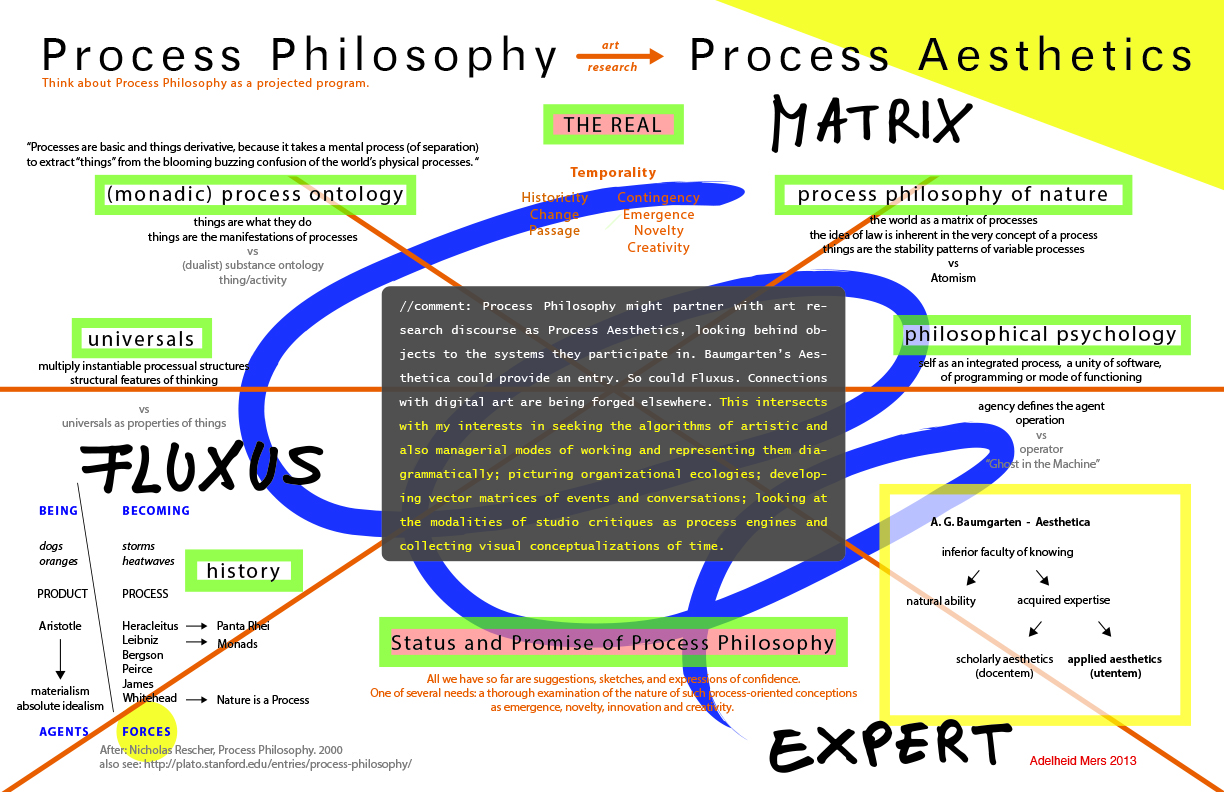
Continued reading on theories of knowledge led to Nicholas Rescher’s writing on Process Philosophy. Here’s a first stab at connecting it to my thinking about critique, about Baumgarten’s aesthetics as a discussion of art making and appreciation, artist’s individual epistemes and the art research discourse. This text also helped me to better understand why any ontology but a process ontology has always seemed nonsensical to me.

Image


Posted in remarks

Adapting Techniques of Studio Critique for Arts Management Pedagogy

The Journal of Arts Management, Law, and Society, Volume 43, Issue 2
Special Issue: Arts Management Education

Adapting Techniques of Studio Critique for Arts Management Pedagogy
Adelheid Mers

pages 88-97

http://www.tandfonline.com/doi/abs/10.1080/10632921.2013.775980#.UciM6z6Uvip

Posted in publication

ETSU Outer Regions Follow-up: on diagram use

A discussion of diagram use throughout the roundtable conversations, “Complex Models”, Posted in Temporary Art Review.

Posted in 3Line_Matrix, conferences