Dispositions of cultural funding – call for papers – Kufstein, Austria

Dispositions of cultural funding

Cultural funding structures and their consequences for cultural production and reception

The 8th Annual Conference of the Fachverband Kulturmanagement focuses on the interdependency between financing systems and the production and reception of cultural goods and processes. Artistic practice and cultural activities do not simply happen by themselves, but rather refer – by their results and effects – to their conditions of creation. Which theory-based approaches can cultural management use for contributing to a debate on cultural funding that allows for authenticity, innovation and diversity in the cultural field? How can cultural management influence the forming of support criteria and structures? What financing models, apart from the existing ones, could be envisaged in order to strengthen alternative forms of cultural production?

Full call, German and English:

http://www.fachverband-kulturmanagement.org/8-jahrestagung-des-fachverbands-kulturmanagement/

Posted in conferences

3-Line Matrix Nick Prior/Bourdieu

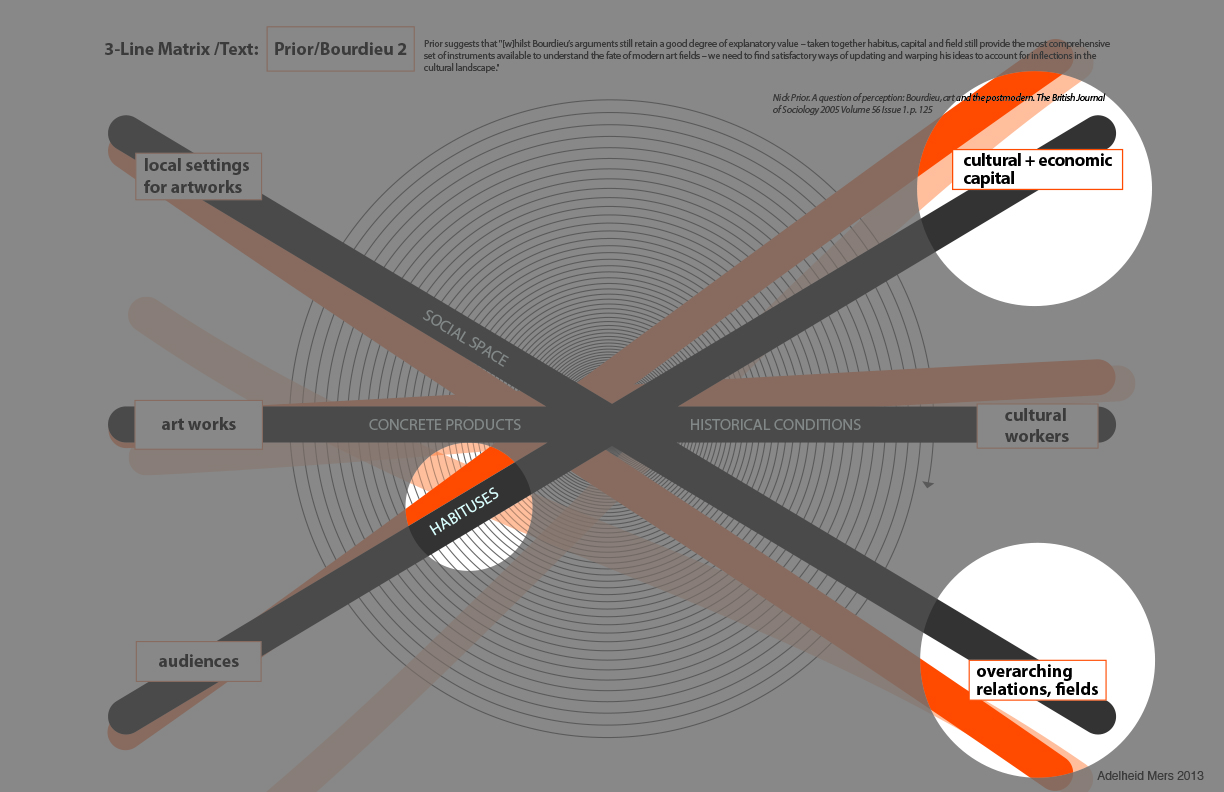
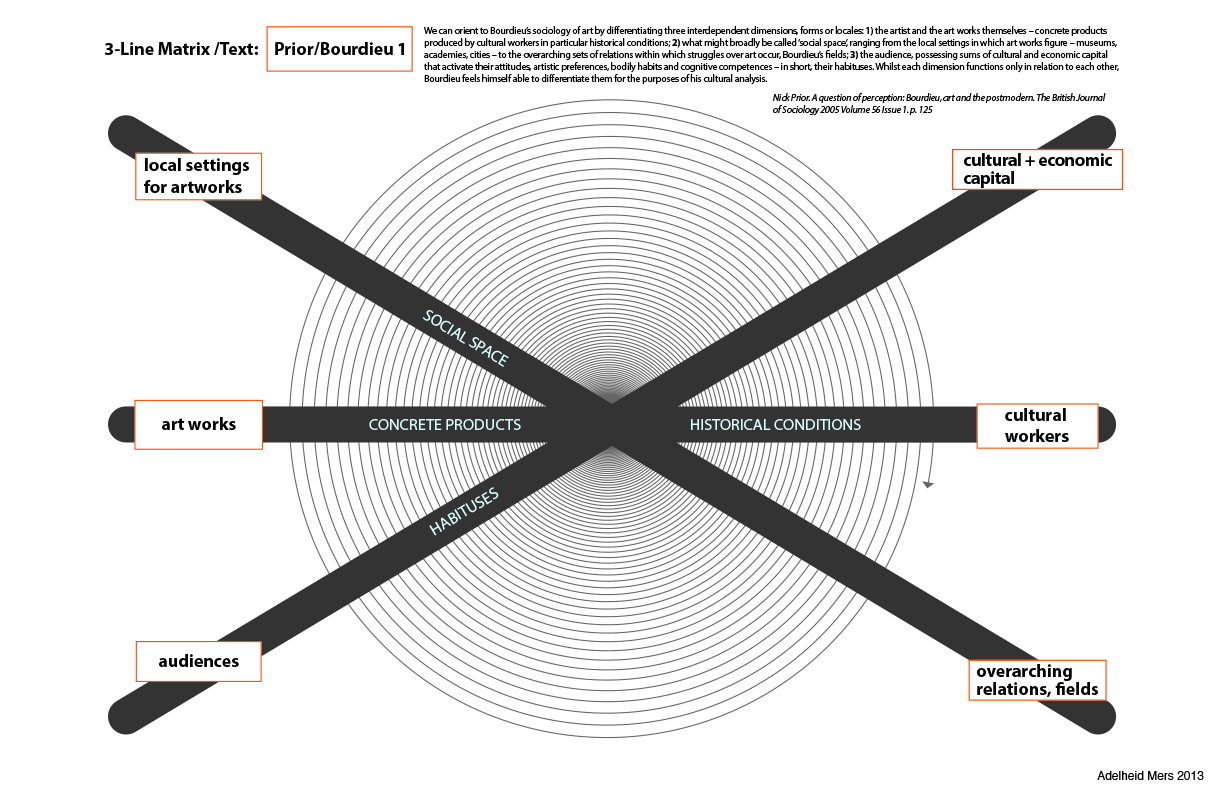
Here’s a 3-Line Matrix visualization of a concise summary of Bourdieu’s sociology of art, by Nick Prior:

“We can orient to Bourdieu’s sociology of art by differentiating three interdependent dimensions, forms or locales: 1) the artist and the art works themselves – concrete products produced by cultural workers in particular historical conditions; 2) what might broadly be called ‘social space’, ranging from the local settings in which art works figure – museums, academies, cities – to the overarching sets of relations within which struggles over art occur, Bourdieu’s fields; 3) the audience, possessing sums of cultural and economic capital that activate their attitudes, artistic preferences, bodily habits and cognitive competences – in short, their habituses. Whilst each dimension functions only in relation to each other, Bourdieu feels himself able to differentiate them for the purposes of his cultural analysis.”

Print

Organized in this manner, general, or overarching terms fall onto the right side of the matrix, while their enactments congregate on the left side. The axes provide the themes.

Audiences manifest Capital filtered through Habitus.

Art Works manifest Cultural Workers filtered through  Concrete Products/Historic Conditions.

Local Settings manifest Fields filtered through Social Space.

Print

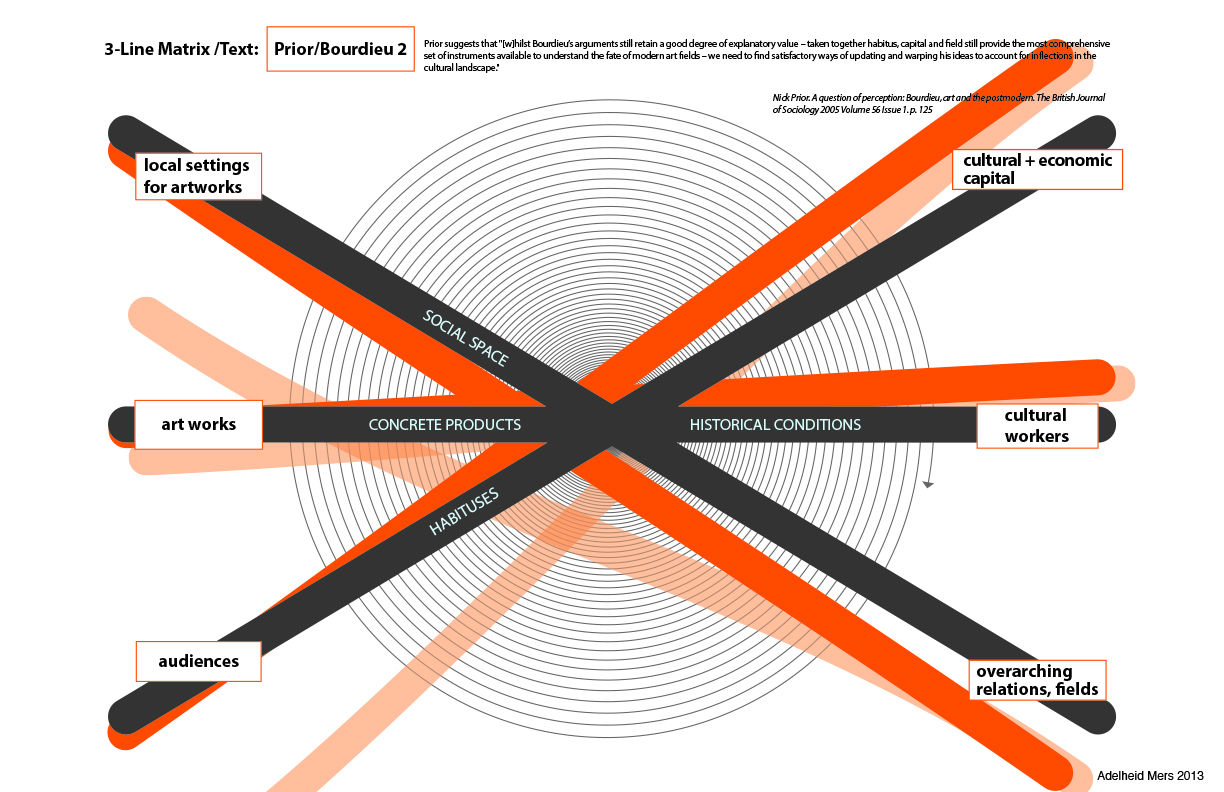
Prior suggests that “[w]hilst Bourdieu’s arguments still retain a good degree of explanatory value – taken together habitus, capital and field still provide the most comprehensive set of instruments available to understand the fate of modern art fields – we need to find satisfactory ways of updating and warping his ideas to account for inflections in the cultural landscape.”

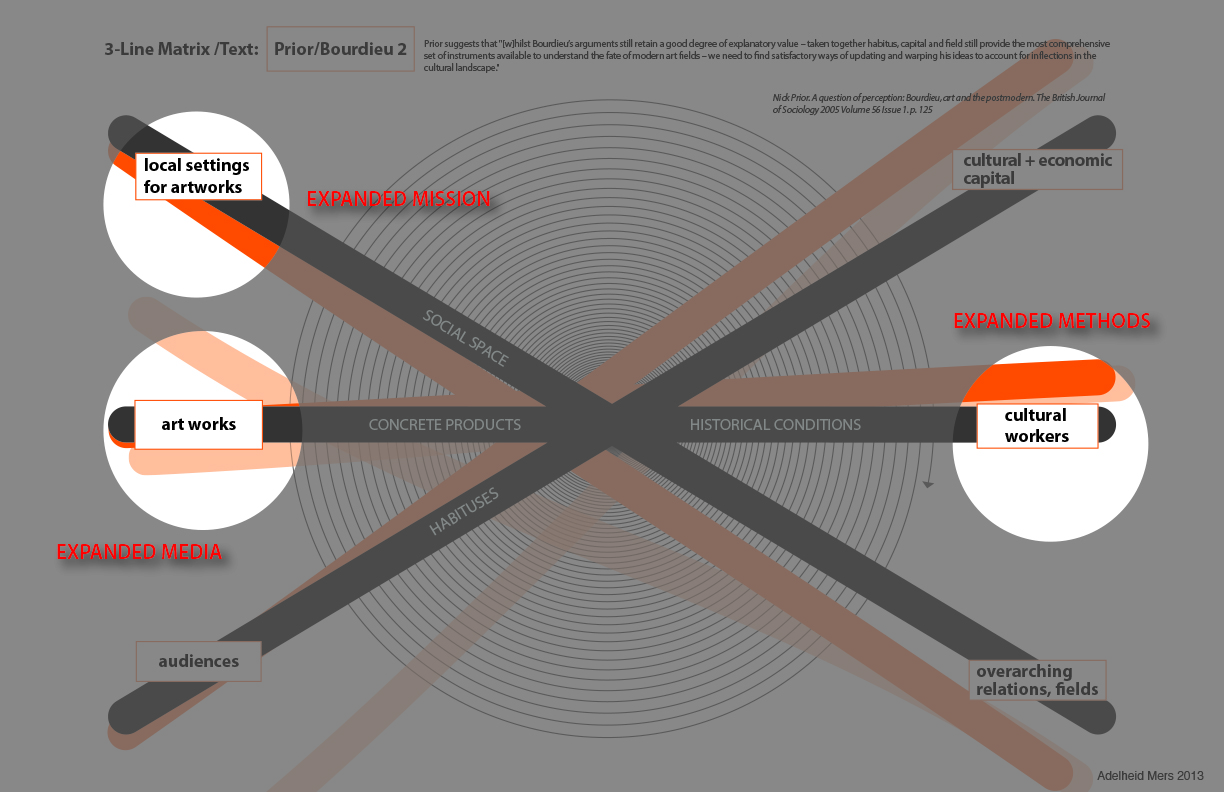
As the lines of the Matrix warp individually, multiple intersections form and the endpoints smear out at different rates.

Print

Prior names Habitus, Capital and Field as the instruments Bourdieu provided. Emphasis falls on the general side of the Matrix. Since Bourdieu’s focus is a sociology of art reception, the Concrete Products/Historic Conditions axis does not supply an instrument.

Still, in his text, Prior also addresses that museum settings and audiences have shifted significantly, taking into account an increased focus on education by institutions (problematic as it may be), while audiences’ pop culture consumption is pairing with high culture appreciation. What also needs mention are new art production methods, not limited to new technologies, but also including artist’s scopes, goals and intentions. But, those areas are ‘left in the dark’ if Habitus, Capital and Field are privileged. The question then arises if this system can spawn further instruments.

Print

At a minimum, spotlights on the extended missions of arts organizations and with that on arts policy, the extended media that artworks are deployed in and with that on emerging technologies, and the extended scopes artists are using to make art works and with that on arts epistemologies would be extremely helpful in gauging the system’s complexity, today.

Nick Prior. A question of perception: Bourdieu, art and the postmodern. The British Journal of Sociology 2005 Volume 56 Issue 1. Both quotes: p. 125

Posted in 3Line_Matrix, remarks

Methods Mapping – 48 hour preview

Very intriguing:

Available for Preview April 18/19:

Two + years in the making, Humantific, in concert with OPEN Innovation Consortium is today and tomorrow sharing the preview version of the new book: Innovation Methods Mapping / DeMystifying 80 Years of Innovation Process Design.

This link to the preview will remain live for 48 hours during which time we welcome comments from our readers.

Posted in remarks

Reading Vilém Flusser in North America: Self-made, Do-it-yourself and Doing-it-together

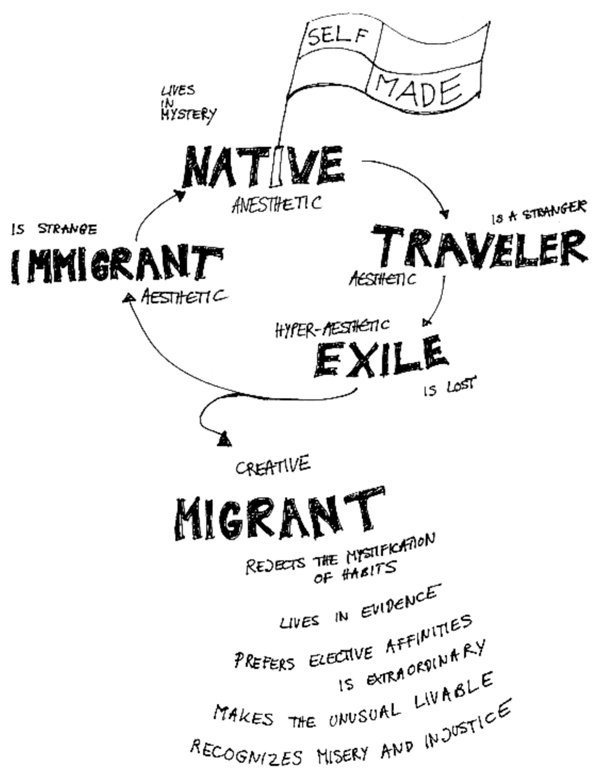
Temporary Art Review just published my text, with diagrams, “Reading Vilém Flusser in North America: Self-made, Do-it-yourself and Doing-it-together”.

Image

Posted in publication

jamming!

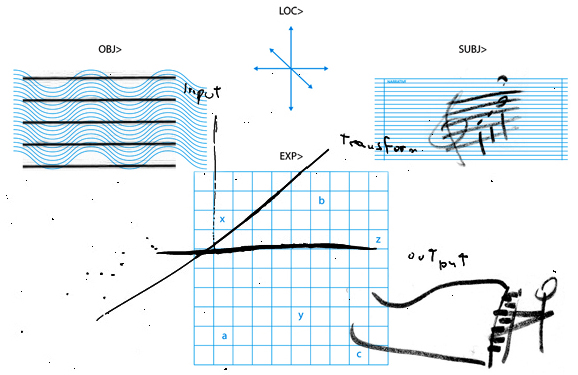
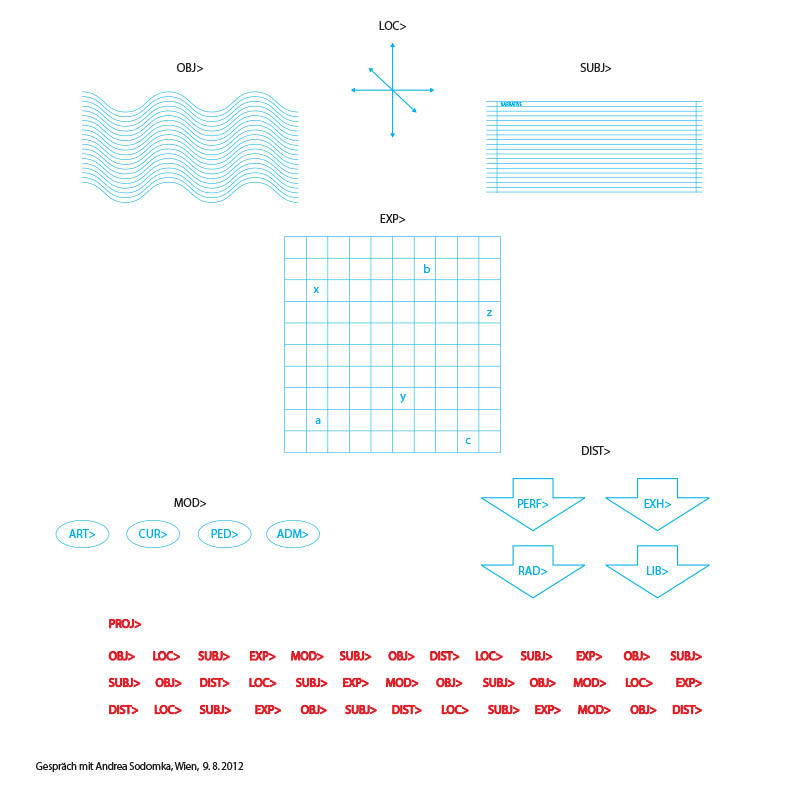
Composers Andrea Sodomka and Rupert Huber recently collaborated for the first time. They realized that my diagram of Andrea’s practice and Rupert’s diagram of his own practice have similarities  – so they morphed both.

http://kunstradio.at/2013A/14_04_13.html

http://alien.mur.at/pics/morpheddiagramm.htmlImage

Posted in art

So, what is this 3-Line Matrix?

It is a multi-dimensional visual thinking tool. A field descriptor. An oblique coordinate system, or a scenario matrix on steroids. A topological device meant to breathe and stretch.

How to use it: In any given discourse, broadly determine 3 prevalent categories. Assign an axis to each. Then name the outlying positions and mark the end points of the axes. Spin the axes around, play with the ordering. Allow affinities and associations between the end points to emerge. Within the field thus sketched out, place other pertinent points. Is the background filling in densely, are hotspots emerging? Can the elements stand to stay in one place? Are they itching to move? What happens to the axes now? Are they starting to oscillate, bend towards each other, grow tentacles, narrow, widen, become more fluid or rigid? Is a field getting established? Does it oscillate? How can it be navigated?
3Line_ETSU copy

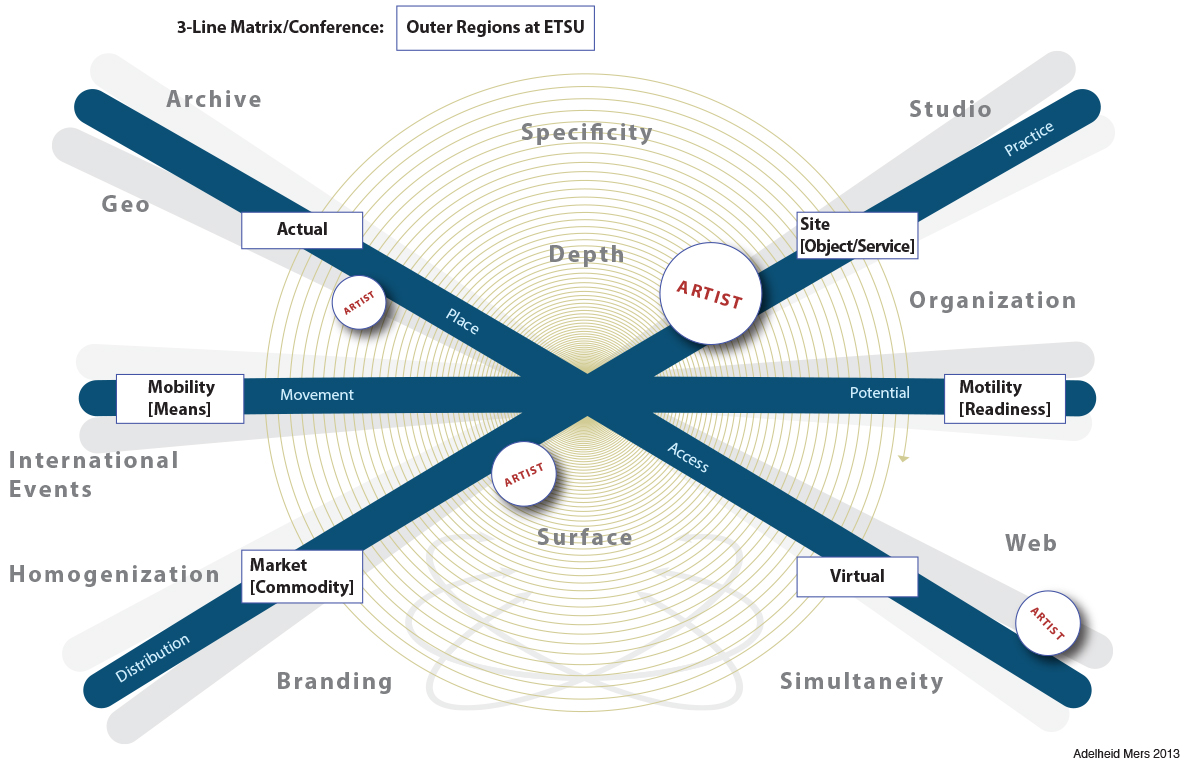
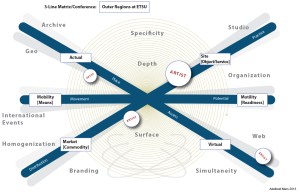
Example 3-Line Matrix conference, ETSU: The overall theme of the Outer Regions conference was how artists work outside of a big, urban center and how they determine their aspirations. Explored were access to networks of peers and gatekeepers, awareness of discourses, confidence, and questions of sitedness of practice. This initially led to the three axes:

1. A practice axis considered the making and distribution of objects. 2. A place axis spanned actual location and facility with and access to virtual reach. 3. A movement axis included both being able to afford and being interested in travel and/or relocation.

At their respective ends, market, mobility and the virtual enable international discourses. There’s a constantly refreshing layer of what is new, just like the most recent information is on top of a Tumblr. The actual, the site of work, and the considerations of motility privilege depth and longer term considerations.  But while they seem to group naturally, these endpoints also exceed conventional narratives and reach towards each other. Web and archive interact with each other. Art making and marketing may trade places. Mobility and motility present constraints and choices. Artists traverse and expand this universe.


Mers1_6018_2013

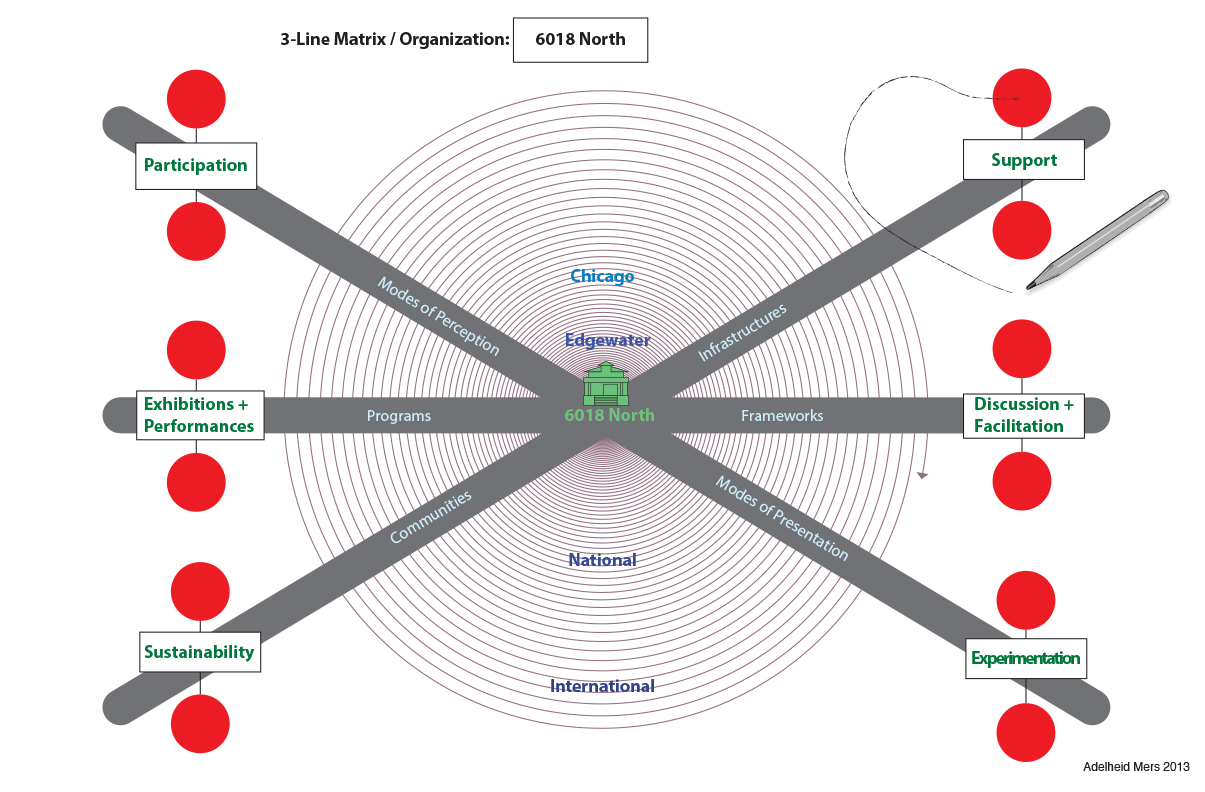
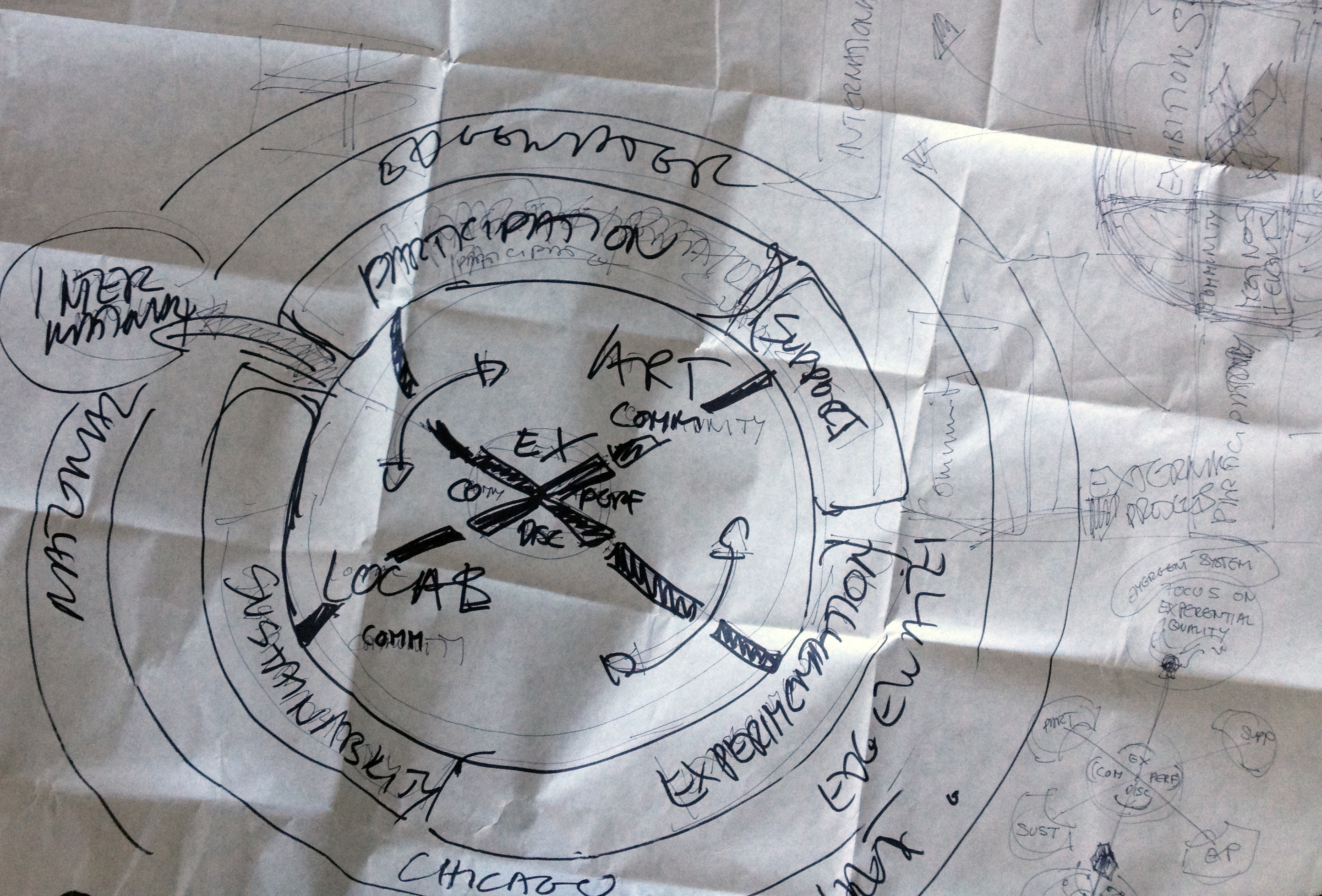
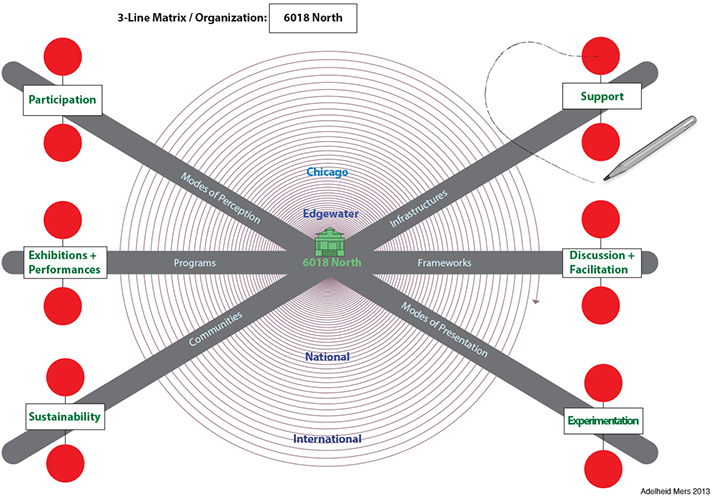
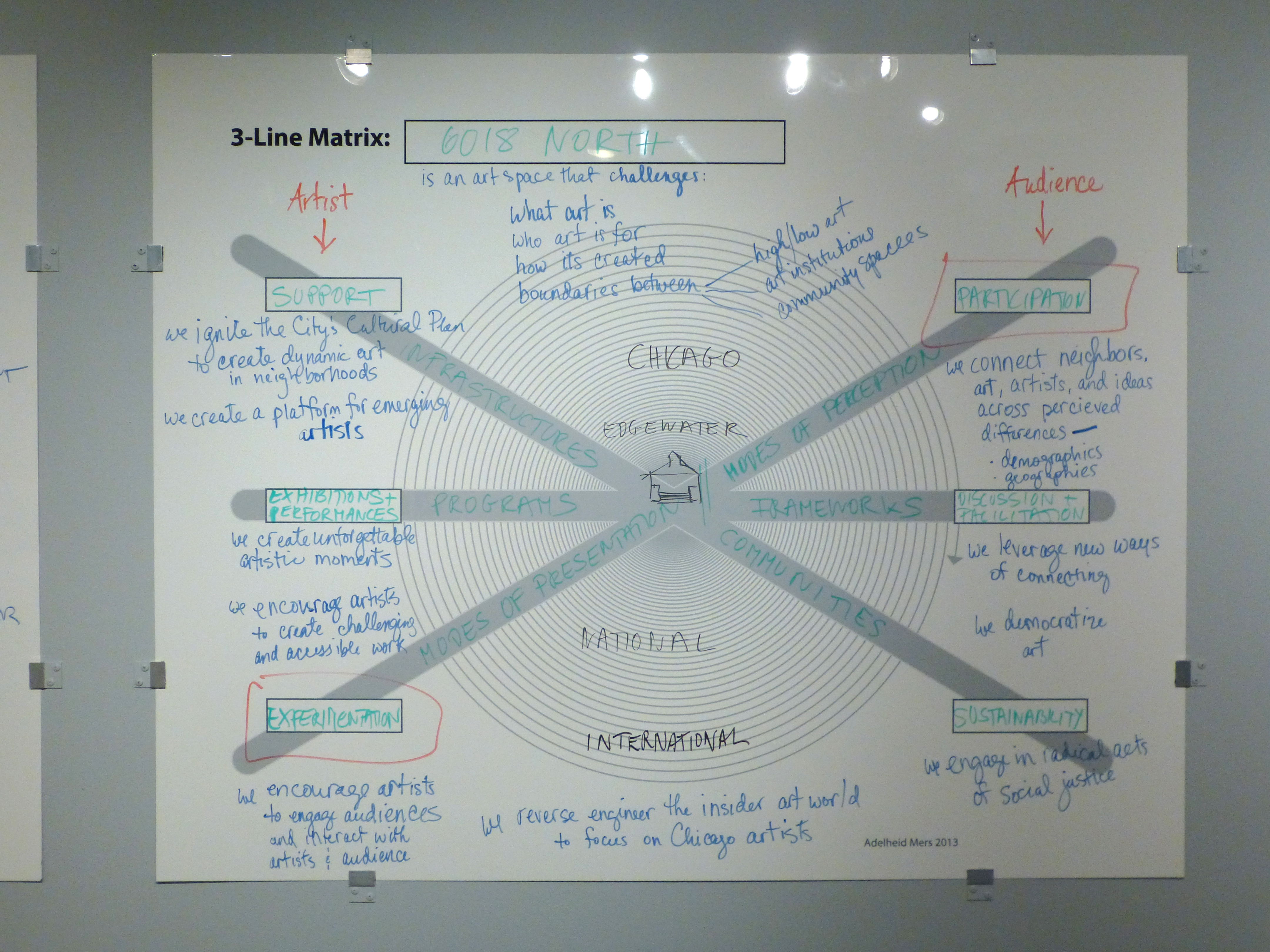
Example 3-Line Matrix organization, 6018North: The non-profit’s mission is shaped around uses of the site and its owner and director’s broader activities as a curator, host and facilitator.

1. A Modes of Perception and Presentation axis speaks to enabling new experiences for both audiences and artists/curators. 2. A Programs and Frameworks axis captures types of events that center on art and on discourse about art worlds. 3. A Communities and Infrastructures axis considers longer-term structures, both of the organization and the field it is part of.

What emerges is a playing field; specific occasions and events can be inserted, also loosely in relation to their physical location.
 

Adel_map copy

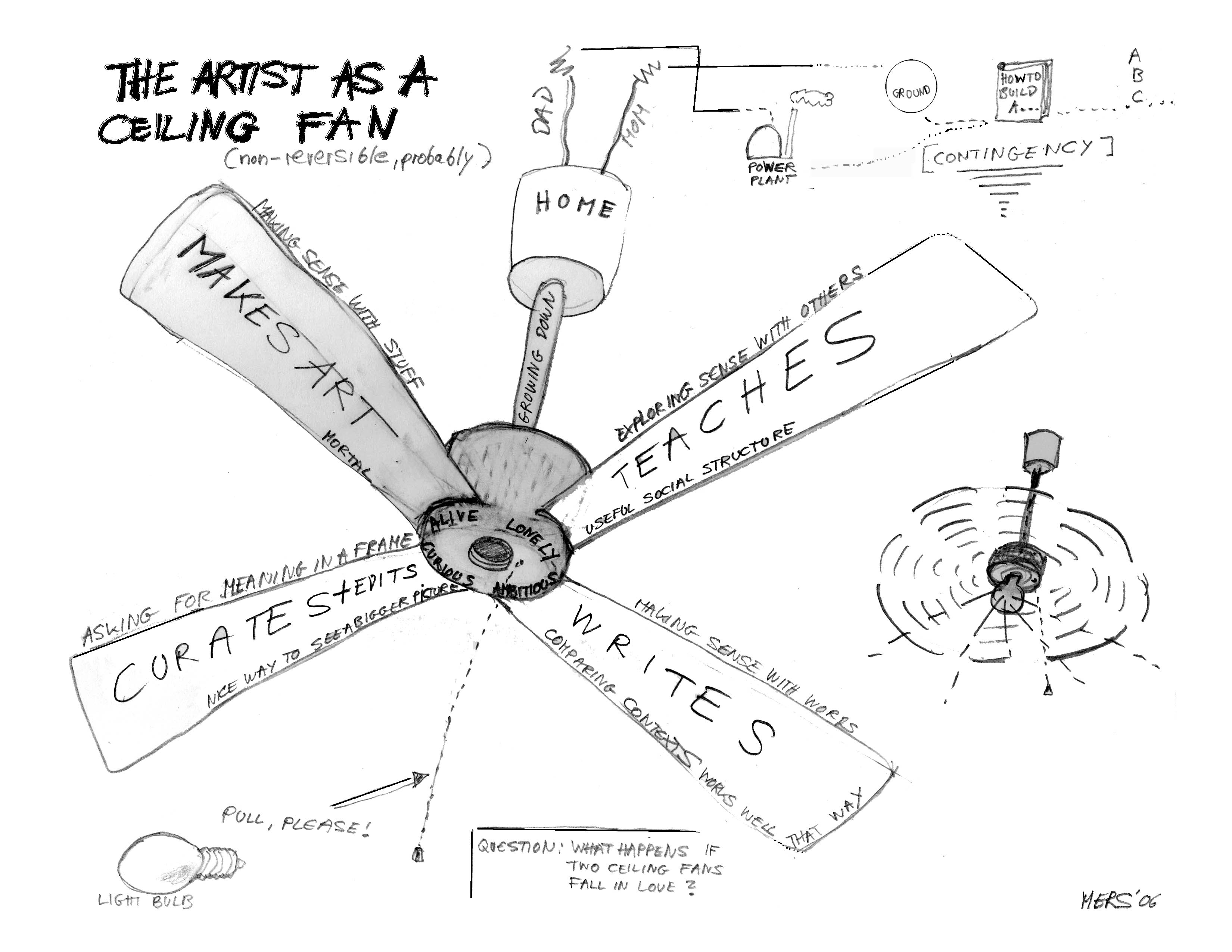
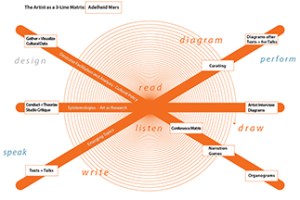
Example 3-Line Matrix art practice, self-portrait: In 2006, I drew myself as a ceiling fan. Clearly, the 3-Line Matrix owes to that image. Recurring formal elements in my artistic practice are: two adjacent focal points, cross, circle, infinity loop. Figure and ground at odds, reversed, or merged. The 3-Line Matrix fits into those patterns.

1. A Cultural Policy axis collects discourse about art contexts, with data visualization on one end and more playful and poetic diagramming on the other. 2. An Art as Research axis addresses discourses about art making. 3. A Topics axis captures thematic explorations, carried out through writing or forms of visualization.

The left field emphasizes linear ways of working – writing and data visualization, along with the presentation of results; the right side collects imaginative making and performative presentation. Both ranges draw from the central intake, reading and listening.


When I talk to other artists about how they work, the diagrams I create based on those conversations (with one exception so far) have not employed this 3-Line Matrix, but generated a range of visual devices that are more specific to the ways of working described to me. I am interested to see if the 3-Line Matrix can be a helpful template to structure an understanding of other’s ways of working.
Tagged with:
Posted in 3Line_Matrix, art, conferences, facilitating

Sounding out Useful Pictures

Believe Half of What You See And None of What You Hear is a project conceived by Georgia Kotretsos, as part of  Sous nos yeux (part 1) curated by Abdellah Karroum at La Kunsthalle of Mulhouse, in collaboration with the University Haute-Alsace (SUAC) and Radio Campus Mulhouse.

My section is listed under DialoguesListen

Wien16 copy

Large copies of the diagrams along with the sound files are here, additional contributions to come.

Sounding out Useful Pictures, 2013

Since 2008, Adelheid Mers has talked to many artists about their work and created diagrams in response. Mers finds patterns in methods and strategies mentioned in those conversations, and also considers contexts that are being referenced, including popular beliefs, market structures, social constructs and personal histories. At best, these diagrams depict the [distributed] cognitive engine that drives an artist’s idiosyncratic practice – as presented at that moment. Mers thinks about her diagrams as attempts to reverse engineer artists’ carefully honed and guarded tacit knowledge with artistic methods – a doubling of applied aesthetics presented through useful pictures.
Adding an additional dimension, Mers is now returning to those artists, asking them to record responses to their diagrams – test and contest their usability – in conversation and/or by creating new sound art works.

Contributors: Andrea Sodomka, Kirsten Leenaars with Tricia Van Eck, Lise Haller Baggesen with Eleanor and Adam, David Court with Carolyn Lambert, Michelle Tupko, Ebby Addo for Saskia Janssen, Ebby Addo for George Korsmit.

Posted in art, exhibitions

The Artist as a 3-Line Matrix

My self portrait, the Artist as a Ceiling Fan, updated:

Adel_map copy

mers_ceiling_fan

Posted in 3Line_Matrix, art

3-Line Matrix: 6018North

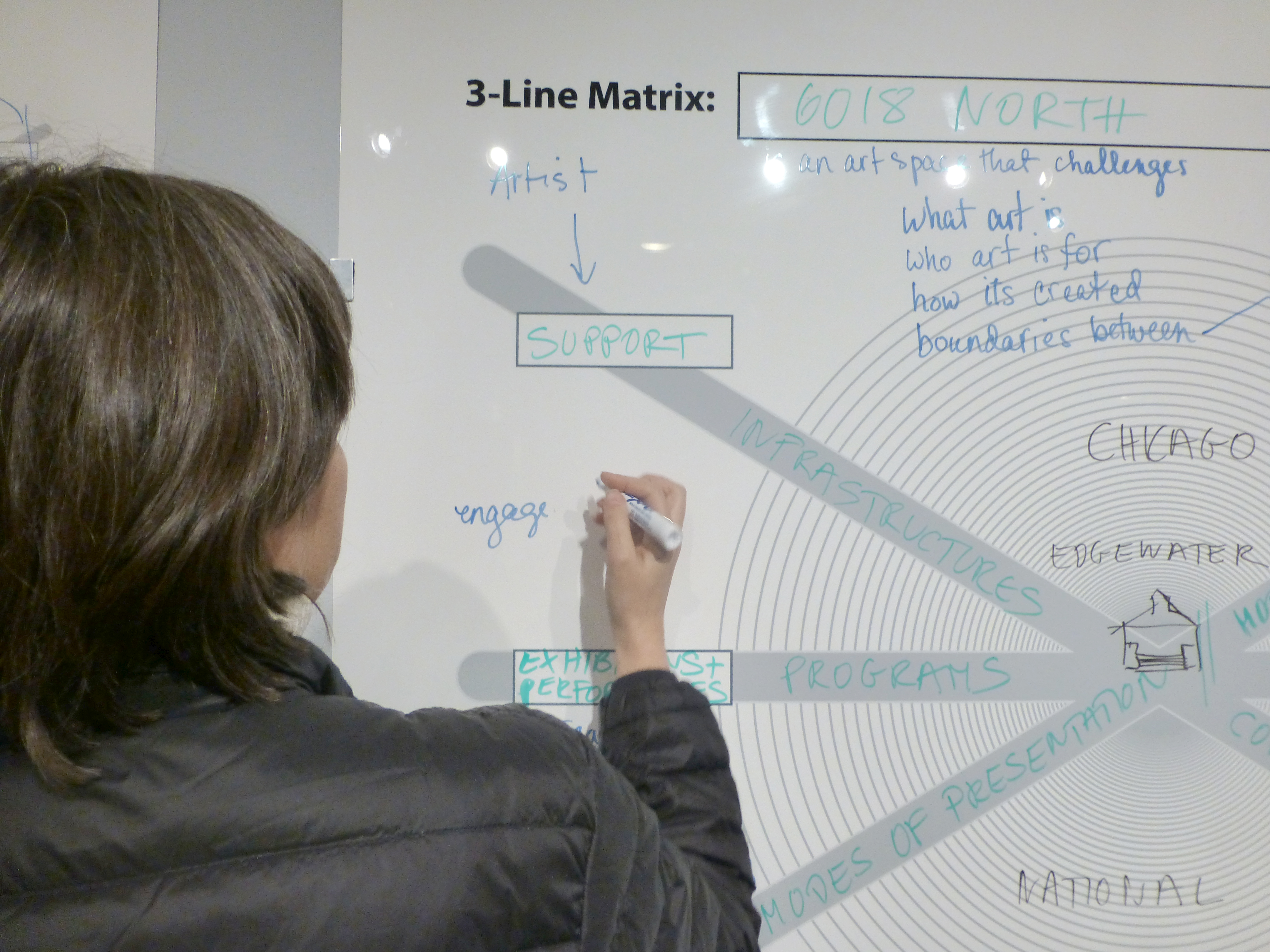
With Tricia Van Eck at 6018 North, discussing her venue’s mission, followed by working out details on a 3-Line Matrix Whiteboard:


Posted in 3Line_Matrix, facilitating

Launch Invitational Residency – Network mapping workshop @ CAC

This wil be fun! Coming June 22nd, 2013.

More here.

Posted in teaching